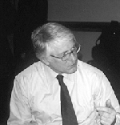
Juan Ramos (left), Senior Advisor to the Director, U.S. NationalInstitute of Mental Health, NIH, in discussion atthe Rockville meeting with Prof. Sadanand Rajkumar from Newcastle University, Australia. Prof. Rajkumar is Secretary ofthe Prevention Section, World Psychiatric Association. |
An invited group of international organizations and governmentagency representatives met in Rockville, Maryland, USA on 28-29April to discuss ways of enhancing collaboration on the evidence-basedpromotion of mental health and prevention of mental and behavioraldisorders worldwide. Some of the participants had alreadytaken part in the two world conferences on the subject heldin Atlanta, Georgia, at the Carter Center in December 2000,and in London in September 2002. Others are involvedin international mental health or have programs already recognized as “best practice” models in the field. Following the successof the two conferences, there has been growinginterest in providing a way to move promotion and preventionforward as public health concepts by forming a consortiumof interested organizations and agencies. The aim is to forman organization which will support cooperation year-round,filling the gap between the biennial conferences.Meanwhile, it is expected that the conferenceswill continue to presentexamples of the latest research andprogram development. (The next conference is in New Zealandon 15-17 September 2004 – see the notice on page2.) InternationalParticipantsThe participants in the Rockville meeting came from ten internationalorganizations, government agencies in Australia, Finlandand the United States, and also the World Bank and the Pan AmericanHealth Organization (which represented the World Health Organization). TheBiennial Conference Committee chaired by former WFMH president BeverlyLong and consisting of the Carter Center Mental Health Program, TheClifford Beers Foundation and the World Federation for MentalHealth, organized the program.The planning process had major involvement from the U.S.Center for Mental Health Services in the Substance Abuseand Mental Health Services Administration of the Department ofHealth and Human Services, withadditional support from the National Institute of MentalHealth in the National Institutes of Health (also withinthe Department of Health and Human Services). Other U.S. agenciesthat sent representatives to the meeting were the Centers forDisease Control and Prevention, and the Center for SubstanceAbuse Prevention.The goals of the meeting were to exchangeinformation about each organization or agency’s currentactivities in promotion and prevention, and to soundout interest in finding a system for collaboration. Before the Rockvilleevent the participants circulated material about their work,andduring the meeting each representative gave a verbal presentationwith further information. All of the organizations andagencies already have substantial activities in promotion and/orprevention, but with many different topics and approaches.Discussion of Concepts
 Prof. Clemens Hosman of Maastrichtand Nijmegen Universities representedThe Clifford Beers Foundation (U.K.) |
 Kaylene Katene, Director of Policyand Business Developmentat the Mental Health Foundation of New Zealand |
General discussion and break-out sessions followed the initialpresentations. The group found major differences in theuse of terminology and in the concepts that were consideredimportant in various parts of the world. Participants debated whetherit isbest to organize promotion and prevention research withina “lifespan” framework, using age-relevantdivisions such as “prenatal and preschool,” “school,” “work,” and “the elderly,” orto focus on more general concepts centered on mental health in thecommunity. Some of those present had done major researchin schools as a desirable location for the early preventionof mental health problems, an example of using the “lifespan” framework.VicHealth (Australia) and the Mental Health Foundation of New Zealandhave created very successful community-wide promotion campaigns,andbrought a different perspective to the table.Prof. SadanandRajkumar, a native of India now working in Australia,reminded the group of the need to make research relevant to developingcountries,and to indigenous communities within developed countries.This was also emphasized by Kaylene Katene, director of policyand business development at the Mental Health FoundationofNew Zealand. She madeher point by opening her presentation to the group in theMaori language.Those present respected many differing viewpoints butallwere interested inestablishing a formal consortium. The organizations arenow reviewing material from the meeting and hope to move forward onthe projectlater in the year.In addition to the Biennial ConferenceCommittee members, the nongovernmental organizations represented were:TheCollaborative for Academic, Social, and Emotional Learning(CASEL). The International Network for Child and Adolescent Mental Healthand Schools.The International Union for Health Promotion and Education(IUHPE). The International Union of Psychological Science(IUPsyS). The Mental Health Foundation of New Zealand.The Society for Prevention Research (SPR).World Psychiatric Association (WPA), Prevention Section.
| Left to right:Eero Lahtinen,Senior MedicalOfficer, Ministry ofSocial Affairs andHealth, Finland,Irene Verins,VicHealth PromotionFoundation,Australia, andDavid McQueen,Associate Directorfor Global HealthPromotion at theU.S. Centers forDisease Controland Prevention. |
 |
| ConferenceThe Third Global Conference onthe Promotion of Mental Healthand Prevention of Mental andBehavioural Disorders will be heldon September 15-17, 2004 inAuckland, New Zealand.For information, please contact:Mental Health Foundation of New ZealandP.O.Box 10051 • Dominion RoadAuckland, New ZealandTel: 0064 (0)9 300 7010Fax: 0064 (0)9 300 7020Email: [email protected]Web site: www.mentalhealth.org.nz |
|
top
Case Studies Needed
New Book on Promotion Projects
The World Federation for Mental Health and the WHO Departmentof Mental Health and Substance Dependence are collaboratingon a project to collect and publish case studies of mentalhealth promotion programs, initiatives and strategies. About60 programs will be selected to appear in a planned bookon Mental Health Promotion: Case Studies from Countries,which will provide international examples to foster the growthof promotion activities. The Federation would like to hearfrom people working in this field – take advantage of thischance to publicize your efforts! Organizations are warmlyinvited to send in descriptions of mental health promotionprograms that have been implemented locally, nationally oracross countries. The time required to prepare a projectdescription should not be too demanding – the length requestedfor a case study narrative is 1,000- 2,000 words (manuscriptsof more than 2,000 words will not be considered). The programsshould have been completed recently (after 2000). Submissionswill be forwarded to WHO, which will select the programsto appear in the book. The deadline is 30 September 2003.The required format for the submission is available on theWFMH web site (www.wfmh.com, click on New Initiatives atthe top of the home page). Instructions for submitting aprogram can also be obtained by email, fax or post from:Deborah MaguireWFMHP.O.Box 16810Alexandria, VA 22302-0810, USAFax: 703 519 7648Email: [email protected] |
|
World Mental Health Day10 October 2003Emotional and BehavioralDisorders of Children and AdolescentsThe WorldMental Health Day information packet for 2003 is now available on theInternet inEnglish, French and Spanish (www.wmhday.net), and is being mailed inJuly to organizations participating in this year’s campaign.Although 10 October is officiallyWorld Mental Health Day, as alwaysWFMH supports maximum flexibilityin the national and local campaigns,where organizers are free to selectanother date if it is more convenient (or, as often happens, to extend theirprogram to a week or a month). Some organizers choose to combineanother theme with that of the informationpacket, depending on theirown public education goals. Othersdevelop a local theme only, usingthe international Day to add significanceto their mental health educationcampaign.This year the Federation’s programhas two goals. It seeks to draw attentionto the broad range of emotionaland behavioral problems that affectchildren and adolescents, and to thesurprisingly high rate at which theyoccur. It also draws attention to thefact that almost nowhere are thesedisorders specifically recognized inpublic health policy, except as anadjunct to adult mental health.The 112-page booklet prepared bythe Federation contains fact sheets ona range of problems, designed toenable organizers to select materialconveniently for reproduction and/ortranslation. The subjects covered areadolescent substance abuse, adolescentsuicide, anxiety in children,attention-deficit hyperactivity disorder,autism and other pervasive developmentaldisorders, bipolar disorder,depression in children, disruptivebehavior, eating disorders, learningdisabilities, schizophrenia, sleepdeprivation, tics and Tourette’s disorder. A fact sheet on children living infamilies affected by HIV/AIDS emphasizesthat they face exceptional problems.These should be recognized inthe individual family’s situation, butin some countries there is also a needto recognize the enormous consequencesfor society as a whole.In addition to providing basic informationabout serious disorders ofchildhood and adolescence, the campaignseeks to publicize the lack ofattention to young people’s mentalhealth in the public health programsof almost all countries. A section ofthe World Mental Health Day packetprovides “A Citizen’s Guide to Advocacyfor Creating a National Childand Adolescent Mental Health Policy,” together with a suggested ActionPlan for a Policy Advocacy Coalitionand an example of such a plan fromSouth Africa.Another section reviews advancesin child and adolescent mental healthresearch. Early intervention can oftenmodify the course of disorders. Treatmentsexist, but are unavailable inmany places because of lack ofresources (including lack of trainedprofessionals). A shift in the publichealth approach to the situationwould affect many young lives.It is not too late for organizations tojoin the effort to draw attention tochildren’s mental health issues. Checkthe web at www.wmhday.net toreview and download the informationpacket.To receive the material bypost, send a message to the Secretariatby email at[email protected], or contact:Deborah MaguireWFMHP.O.Box 16810Alexandria, VA 22302-0810, USAFax: 703 519 7648top
Conferences
Mental Health Chair of Scientific Program:Prof. Donna StewartMarch 17-20, 2004Marriott Wardman Park HotelWashington DC, USAwww.womenmentalhealth.comTo register:2nd World Congress Registration Center11212 Waples Mill RoadSuite 104Fairfax, VA 22030, USATel: 888 414 7127 or703 449 6418Fax: 703 631 6288Conference Secretariat:8213 Lakenheath WayPotomac, MD 20854, USATel: 301 983 6282Fax: 301 983 6288Email: [email protected]World Congress for Psychiatric NursesSponsored by the RegisteredPsychiatric Nurses of CanadaMay 6-8 2004Winnipeg, Manitoba, CanadaTel: 204 888 4841Details from:www.psychiatricnurse.ca |
|
At the UnitedNations
New Leader at WHODr. Jong-Wook Lee will take office asDirector-General of the World HealthOrganization on 21 July 2003 for afive-year term. He is the first personfrom South Korea to lead a UnitedNations agency. He succeedsDr. Gro Harlem Brundtland, whohas held the position since July 1998.Dr. Lee has worked at WHO fornineteen years. He was nominated bythe Executive Board at its meeting inJanuary, and elected by the WHOAssembly of the 192 Member Stateson 21 May. An expert on infectiousdiseases, his work has focused onthe prevention of tuberculosis andthe program for vaccinations andimmunizations.In his acceptance speech to theAssembly he declared a commitmentto improving primary health care andachieving clear, measurable results incountries. As a result of the SARS outbreakshe also saw an urgent needfor “stronger disease surveillanceand response mechanisms” aroundthe world.Moves toward aNew Conventionon DisabilityThe 16-27 June meeting of the UnitedNations Ad Hoc Committee on aComprehensive and Integral InternationalConvention on Protection andPromotion of the Rights and Dignityof Persons with Disabilities has led tofurther progress towards creating anew UN convention. The meeting inNew York was at government level,with strong advocacy by people withdisabilities and organizations representingthem.Members of the NGO caucusdecided to refer in their material todisabilities in general rather thanspecify different kinds of handicap.Their hope is that this will lead to a more unified advocacy from organizationsrepresenting disabled people,and to the drafting of as broad a conventionas possible. The World Networkof Users and Survivors of Psychiatry(WNUSP) presented asubmission to the Ad Hoc Committeefollowing this strategy and supportingthe need for a Convention.A Working Group is being establishedto prepare a draft text, includingoptional material, for a Convention.This will become the basis fornegotiation by Member States at thenext Ad Hoc Committee meeting inMay/June 2004.The Working Group will consist oftwenty-seven government representatives,together with twelve representativesof NGOs representing personswith disabilities. There will also be arepresentative of national humanrights institutions. The Working Groupwill meet at UN Headquarters in NewYork for a ten-day session early in2004.The official documents of the AdHoc Committee have been posted onthe Internet (www.un.org/esa/socdev/enable/rights/adhocmeetings.htm).For daily bulletins and summaries seealso www.rightsforall.org/updates.php (theweb site of the Landmine Survivors Network).World FederationFor Mental HealthRepresentation atthe UN
- New YorkWFMH Main Representative NancyWallace was elected as chairpersonof the NGO Committee on MentalHealth in June. The outgoing chair isGiovanni Caracci of the World PsychiatricAssociation, who remains onthe Committee ex officio.Pamela Collins, M.D., has resignedas a representative because of othercommitments. Her place has beentaken by Richard Donahue, who wasalready active on behalf of the Federationin the NGO Committee onMental Health.
- Geneva Dr. Stanislas Flache has retired as theFederation’s senior representative inGeneva, effective 1 July (see page 7).The position will now be heldby Myrna Merritt Lachenal.Ms. Lachenal has extensive publichealth nursing experience in thePhilippines, Laos and Switzerland.She served as a WFMH UN representativein Geneva from 1990 to 1995,and resumed that role earlier in 2003.Her interests reflect her early nursingexperience in Asia, and includeissues affecting women and children,refugees and migration, and humanrights and mental health.
top
Conference inItaly
TransculturalPsychiatry andMan-made Disasters The Italian Institute of TransculturalMental Health (Instituto di IgieneMentale Transculturale, IMT) headedby Prof. Goffredo Bartocci, togetherwith the township of Narni, Umbria,hosted a conference on transculturalpsychiatry and the mental health ofvictims of man-made disasters from9 to 15 June 2003. The meeting wasorganized in partnership with theEastern Mediterranean RegionalCouncil of WFMH, headed byAhmed El Azayem, M.D., and theWorld Islamic Association forMental Health.The historic town of Narni, whichwas at its peak of influence betweenthe 12th and 14th centuries, provideda picturesque setting for the conference.The program covered issues ofinterest to Mediterranean countries,including mental health concepts inWestern and Muslim countries and problems of social integration. Someof the sessions examined the violencein Palestinian communities, and aspecial focus was given to providingteachers with a variety of ways tohelp young children process theirtrauma. Several of the speakersaddressed this issue. Participantscame from Bosnia, Egypt, Gaza, Italy,Pakistan, the United Kingdom and theUnited States.Input from WFMH included presentationsby the Federation’s formerpresident, Ahmed El Azayem, M.D.,and by Dr. Leila Dane of the Institutefor Victims of Trauma (a memberorganization) on conflict resolutionand programs to prevent conflict.Dr. Dane presented a comprehensivetool for mental health professionalsworking in wartime or post-war situations,the American PsychologicalAssociation/ Canadian PsychologicalAssociation Ethnopolitical WarfareInitiative Curriculum. (This is availableon a number of Internet websites, including that of the EPW Initiativeat cpa.ca/epw/epw and Psychologistsfor Social Responsibility atwww.psysr.org).Syed Arshad Husain, M.D., head ofthe International Center for PsychosocialTrauma, University of Missouri (aWFMH Collaborating Center) spoke from his long experience in developingculturally-based interventions fortraumatized children, and about managinggrief and loss.Cairo Conference onCare of HandicappedPeople The next meeting in which theEastern Mediterranean RegionalCouncil of WFMH will collaborate isthe First Pan Arab AfricanConference for the Care andRehabilitation of the Handicapped.WFMH Regional Vice PresidentAhmed El Azayem is Vice Presidentof the conference, which will takeplace at the Cairo Meridien Hotel,1-3 October 2003. The deadlinefor the call for abstracts is31 August 2003.Conference Secretariat:Medical Design Center(Dr. Wagdy Ishak)P.O.Box 106 Panorama October11811 Cairo, EgyptTel/fax: 202 414 8089(also 202 761 4974)Email: [email protected](also [email protected])
Mental Health Europe
Mental Health Europe (MHE)will hold its annual GeneralAssembly in Paris on 20 October.Tel: 32 2 280 04 68Fax: 32 2 280 16 04Email: [email protected]The 2nd Citizens’ Mental HealthForum will be held in ParisCity Hall on 21-22 October.It is organized by a group ofFrench associations in co-operationwith MHE.Contact Advocacy France:Tel/fax: 33 231 94 70 25Email: [email protected] |
|
 Left to Right: Conference participants Ronald Wintrob, GoffredoBartocci,Syed Arshad Husain and Wayne Anderson in Narni, Italy. |
top
WFMH HOSTS INTERNATIONALPSYCHIATRISTS AT APA FORUM
The World Federation for MentalHealth took the first step in anew outreach initiative to attractmore mental health professionals toits membership by hosting an “InternationalPsychiatry and MentalHealth” Forum and Reception duringthe annual conference of the AmericanPsychiatric Association (APA) inMay. This year’s meeting in SanFrancisco, California, was one of thelargest ever held by the APA, andmore than 7,500 of the participantscame from countries other than theUnited States.WFMH was able to schedule anAllied Group Meeting during the conferencethrough the assistance andsupport of a number of past and presentleaders of the APA, including itsformer Medical Director Dr. MelvinSabshin (a past WFMH board memberand Regional Vice-President), EllenMercer (who previously directed theAPA’s International Affairs Office),and Dr. Rod Munoz and Dr. BobPasnau (both of whom have longsupported the APA’s engagement in international psychiatry). Representativesof national psychiatric associationsfrom countries around the worldwere invited to attend the Forum, tomeet WFMH President L. Patt Franciosiand Secretary-General/CEOPreston Garrison, receive an updateon WFMH’s activities, and to shareinformation about the status of mentalhealth in their own countries andregions.The forum attracted representativesfrom a number of countries, includingthe presidents of the national psychiatricassociations in Canada, Greece,Ghana, Kenya and Norway. Dr.Marcia Kraft Goin, who assumed thepresidency of the APA at the annualconference, was also in attendance,along with Dr. A. L. Halpren andother APA international psychiatrysupporters. Dr. Franciosi, boardmember Richard Studer, volunteerMildred Reynolds and PrestonGarrison represented WFMH. EllenMercer, who chaired and helped toorganize the event for WFMH, waslater honored for her work on behalf of international psychiatry at a specialreception held in her honor.As Dr. Franciosi noted in her welcomingremarks, “WFMH has enjoyed andbenefited from a long history of supportand participation of members of the psychiatricprofession, and from professionalsworking in other disciplines whorecognize the need for a strong, wellorganized,multi-disciplinary advocacyorganization such as WFMH. Throughthis first step in what will be an ongoingoutreach initiative to professionals workingin mental health globally, we areworking to increase WFMH’s membershipand to build strong and effectivecollaborations on such major issues asHIV/AIDS and mental health, child andadolescent mental health, and theincreasingly damaging affects that war,violence, and trauma are having on themental well-being of our fellow citizensworldwide.”The “International Psychiatry andMental Health” Forum and Receptionwas supported through a general educationgrant from Pfizer PharmaceuticalsGroup.
|
Ellen Mercer (left) andPatt Franciosoi (right)with guests at the receptionfollowing the WFMH Forumat the APA’s San Francisco meeting.APA Past President Rodrigo Munoz, M.D.,is third from the right.
|
|
top
DR. FLACHE RETIRES AS WFMHGENEVA UN REPRESENTATIVE
 Stanislas (“Stan”)Flache, M.D. |
|
Stanislas (“Stan”) Flache,M.D., since 1984 the Federation’sSenior Representativeto the United Nations’World Health Organizationand other Geneva-based unitsof the United Nations, hasannounced his retirement fromthat important post. He wasappointed to the position bythe 1983-1985 WFMH President,Dr. Estafania Aldaba-Limof Manila. His abilities weresoon recognized in the organizationand he was chosen asWFMH President-Elect for the1987-1989 term. He became President during the AucklandWFMH World Congress in1989 and held that office until1991.Dr. Flache, a French citizenresident in Geneva, wastrained in both medicine andpublic health. He graduated inmedicine from Montpelier andin later career, under WHOauspices, took post-graduatetraining at Harvard. Beginningas a medical officer with the UNRelief and Rehabilitation Agencyin Europe after World War II, hebecame Director of Health forthe UN Relief and Works Agencyin the Middle East where he wasconcerned with Arab refugees inJordan, Syria, Lebanon andGaza. He devoted the bulk ofhis professional career to WHO,serving as WHO Chief MedicalAdvisor to UNICEF headquarters,New York, and Director ofHealth for the WHO-WesternPacific Region in Manila whereDr. Aldaba-Lim came toknow him.In 1977 his work was recognizedby his elevation to theposition of WHO Assistant DirectorGeneral which he held untilhis retirement in 1981. In thatrole he was responsible for severaldivisions concerned withbiomedical information as wellas for WHO offices outside ofGeneva.In his WFMH capacity,through his continuing personalrelationships with UN leaders aswell as his dedication andenergy, he greatly strengthenedour ties to WHO. He was particularlyactive in regard to thehuman rights of patients, especially those detained in mentalhospitals against their will. Hewas also an active consultantin the development of the precursorof Mental HealthEurope, then known as theEuropean Regional Council ofWFMH.I value my long associationwith Stan, both as a key colleaguein furthering the missionof the Federation, and as ahuman being tempered byseverely stressful life experience.As an adolescent hemanaged to escape from NazioccupiedPoland, losing a familywhose precise fate he neverdiscovered. By dint of his ownefforts and talent he was ableto become a French citizenand gain admission to universityto study medicine at Montpelier.These experienceshelped form his special empathyfor oppressed persons andcontributed to his work as aphysician, a global publichealth administrator, and a volunteerwith our world-wide,multi-national and multi- cultural,non-governmental organization.It has been a privilege toshare with him a vision of whatWFMH might accomplish.Stan did steadfast work for theFederation, and I hope that hewill long continue his associationwith it in an advisory capacity. Iknow we can count on his wisdomand continued interest.Eugene B. Brody, M.D.WFMH Senior ConsultantPast President (1981-1983)Past Secretary General(1983-1999) top
 Messagefrom the President
Dear Friends,One of the great privileges of being WFMH President is receivingmail from around the world expressing appreciation for the supportWFMH provides for national and local advocacy efforts and the educationalmaterials we distribute throughout our global network.Sometimes it is hard to comprehend the difference WFMHmakes in the lives of people in so many countries withoutthese messages. For example, this week I received a letterfrom a mental health nurse at the Zimba Mission Hospitalin Zambia. Joyce Haakalake wrote to tell us of her successin organizing a full day of activities for last year’sWorld Mental Health Day including a march past the localCouncil Chambers, a program of speakers, and local entertainmentwhich ended with the singing of the National Anthem ofZambia and a prayer.Mrs. Haakalake has asked that we not forget her and pleaseremember to send her materials for this year’s World MentalHealth Day. She states “this year I hope to do even betterthan last year.” I was very touched by her letter and enthusiasm.She is one of those special people who works very hard,using the resources at hand, to make a difference in thelives of others.A mental health nurse in Zambia, a consumer of mentalhealth services in Japan, a family member in Australia,a psychiatrist from Egypt, and concerned citizens all overthe world. These are the people who are members of theWorld Federation for Mental Health’s family, willing todedicate their time, talents and caring to make the worldin which we live, in some small way, healthier for all.We have another important opportunity this year to focusour efforts on a major mental health concern. This year’sWorld Mental Health Day topic is “Emotional & BehaviouralDisorders of Children and Adolescents.” The materials forthis year’s campaign illustrate very clearly that we arefailing to meet the mental health needs of the childrenin our global society. It is time that we end the stigmaand discrimination attached to mental illnesses and thatwe give all children the opportunity to reach their fullpotential. I know that many of you will be participatingin World Mental Health Day activities. Please let me knowwhat you are doing, and make sure your national governmentknows that you expect children’s mental health to be includedin its national health policies. L. Patt Franciosi, PhD President |
|
AreYou a WFMH Member? This number of the Newsletter is going to many friendsof the Federation. If you wish to continue receiving it please be surethat your membership is up-to-date. If you are not yet a member, joinus now! We need you and you need an NGO (non-governmental organization)accredited as a mental health consultant to the U.N.Fees for individual membership: developed countries, $35; OECD developingcountries, $1 5; life member $500; and library $35 (U.S.). Your inquiriesor check should go toWFMH1021 Prince StreetAlexandria, Va. 22314-2971USATelephone (703) 838-7543Fax:(703)519-7648Email: [email protected] Website: www.wfmh.orgName and Preferred Title ________________________Address _______________________________________Please send payment in U.S. dollars or other internationally exchangeablecurrency. Payment by credit card is preferred.